

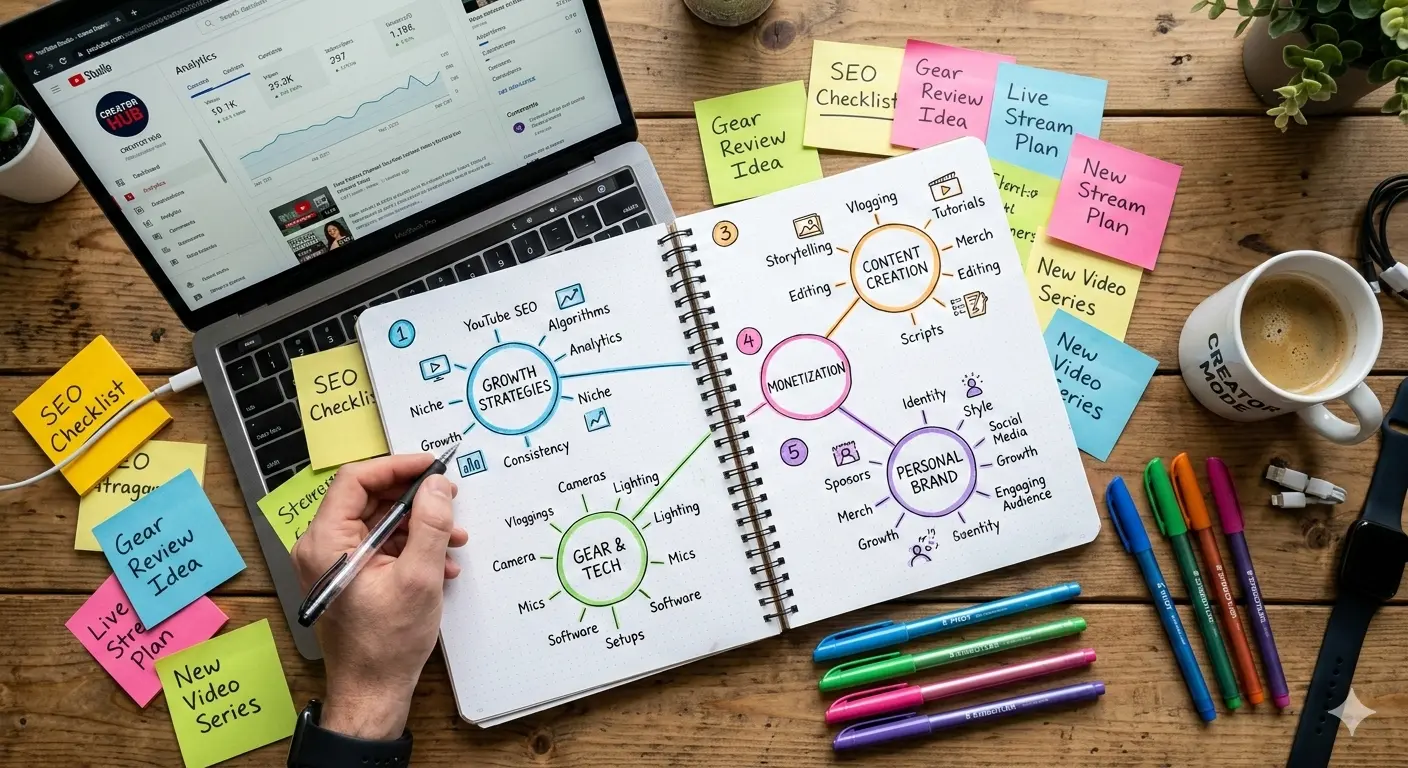
Topic Clustering & Content Neighborhoods: How to Organize Your YouTube Channel for Algorithmic Authority
Key Takeaways
- 1
Topic clustering groups your videos into tightly related content neighborhoods, signaling to YouTube's algorithm that your channel is an authoritative source on a specific subject — not a random collection of uploads.
- 2
Channels that build content neighborhoods around 3-5 core topics consistently outperform generalist channels in search discovery and suggested video placement, because the algorithm can confidently recommend your next video to an already-engaged viewer.
- 3
Each cluster should have a 'pillar video' (a broad, high-search-volume topic) supported by 'cluster videos' (narrower, specific subtopics) — this internal linking and thematic consistency compounds your reach over time.
- 4
Reviewing your channel's engagement data by topic group — not just by individual video — is the fastest way to identify which content neighborhoods are worth expanding and which to retire.
What Is Topic Clustering and Why Does It Matter for YouTube?
Topic clustering is a content architecture strategy in which you group related videos around a central theme, creating what is called a content neighborhood — a set of videos so thematically connected that watching one naturally leads a viewer to watch another. Originally a concept from website SEO, topic clustering has become one of the most powerful channel-growth frameworks available to YouTube creators in 2025.
The core logic is simple: YouTube's recommendation engine does not evaluate your channel as a whole. It evaluates individual videos and asks, "Who else would enjoy this?" When your videos share consistent themes, keywords, audience behavior, and watch patterns, the algorithm builds a reliable mental model of your channel's subject matter. That model is what earns you a spot in suggested videos — the sidebar and end-screen placements that drive the majority of organic discovery on the platform.
If you have ever wondered why your channel feels stuck despite consistent uploading, the answer is often fragmentation. A channel that posts cooking tutorials one week, travel vlogs the next, and tech reviews the week after sends the algorithm contradictory signals. It cannot reliably recommend your videos to a consistent audience, because there is no consistent audience to recommend them to. Understanding this is the first step toward building a channel the algorithm can confidently promote. For a deeper look at how discovery actually works, see Social SEO: Discovery vs. Search — How YouTube's Two Traffic Engines Actually Work.
The Anatomy of a Content Neighborhood
A well-built content neighborhood has three layers:
1. The Pillar Video
The pillar video is a broad, high-search-volume piece of content that defines the cluster's central theme. Think of it as the anchor. It targets a widely searched question or topic — for example, "How to start a vegetable garden" — and it performs best when it is comprehensive enough to satisfy a first-time viewer but specific enough to make them want to explore the subtopics you cover elsewhere on the channel.
2. Cluster Videos
Cluster videos are narrower, more specific pieces that orbit the pillar. Using the same gardening example, cluster videos might cover "The best soil mix for raised bed gardens," "How to prevent pests without chemicals," or "Which vegetables grow fastest for beginners." Each cluster video earns its own search traffic on specific queries while simultaneously reinforcing the pillar video's authority. When a viewer finishes one cluster video, YouTube's algorithm — having observed consistent watch behavior across the neighborhood — is far more likely to serve them another video from the same cluster rather than a competitor's content.
3. Internal Linking and Cross-Promotion
The third layer is the connective tissue: end screens, pinned comments, video descriptions, and cards that physically link cluster videos to each other and to the pillar. This is not just good UX (user experience) — it generates session time, the total time a viewer spends on YouTube after clicking your content. Session time is one of the strongest signals the algorithm uses to determine whether your channel is worth promoting. The more your content neighborhood keeps viewers inside your ecosystem, the more YouTube rewards you with reach.
How Many Clusters Should Your Channel Have?
For most independent creators, the optimal range is 3 to 5 active content clusters at any given time. Fewer than three can make your channel feel thin and limit your total addressable audience. More than five — especially for channels under 50,000 subscribers — often leads to the same fragmentation problem described above, because you are spreading your upload frequency too thin across too many themes to build momentum in any single neighborhood.
The goal is depth before breadth. Build each cluster to at least 8-12 videos before adding a new one. By the time a cluster has that many tightly related videos, the algorithm has enough behavioral data — view duration, click-through patterns, audience overlap — to start recommending your videos automatically, without you having to drive traffic externally every time. For a granular understanding of the metrics that indicate when a cluster is gaining algorithmic traction, see VSAT: The Only Metric That Matters for YouTube Channel Growth.
Identifying Which Clusters to Build First
The fastest way to identify your highest-potential content neighborhoods is to audit your existing videos by theme and compare their performance metrics side by side — not as individual videos, but as groups. Sort your videos into rough topic buckets and look at average view duration, CTR (click-through rate, the percentage of people who see your thumbnail and click on it), and subscriber conversion per cluster. The cluster with the best combined performance across those three metrics is your primary neighborhood. Double down there first.
If you are starting a new channel, use keyword research to identify 3-5 topic areas where search volume is meaningful but competition is not dominated by channels with millions of subscribers. This is the foundation of what strategists call the micro-niche moat — owning a specific content territory so thoroughly that new entrants find it difficult to displace you. For a full breakdown of that approach, see The Micro-Niche Moat Strategy: How to Build an Unbeatable YouTube Channel in a Crowded Space.
Format Choices Within a Cluster
Not every video in a cluster needs to be the same format. In fact, mixing formats within a neighborhood often increases total cluster reach by capturing different viewer intents. A longform pillar video (15-25 minutes) can answer the broad question comprehensively. Shorter cluster videos (5-10 minutes) can target specific subtopics efficiently. YouTube Shorts can act as discovery hooks — brief, high-energy clips that introduce new viewers to your neighborhood and funnel them toward the longer content.
Based on AskLibra data from 4 connected channels and 511 videos analyzed, longform videos generate an average engagement rate of 0.0226, compared to 0.0109 for Shorts — more than double. This does not mean Shorts are ineffective; it means they serve a different function within the cluster. Shorts drive top-of-funnel awareness, while longform builds the deep watch time that signals authority to the algorithm. Use both intentionally.
When crafting the opening moments of any cluster video, your hook rate — the percentage of viewers who watch past the first 30 seconds — is a make-or-break metric. A cluster video with a weak hook bleeds viewers before they ever reach the content that would have kept them watching. For specific techniques to fix this, see Why Your YouTube Hook Rate Is Killing Your Reach.
Titles, Thumbnails, and the Visual Language of a Cluster
One underutilized aspect of content neighborhoods is visual consistency. When your cluster videos share a recognizable thumbnail style — consistent color palette, font, layout, or recurring face expression — returning viewers identify your content instantly in their feed, increasing CTR without any additional effort. New viewers who click one video and enjoy it are more likely to click a second video when the thumbnail signals "same creator, same quality, same topic."
This is sometimes called thumbnail branding, and it functions as a trust shortcut. The viewer does not need to read the title carefully; the visual pattern does the persuasion for them. For a data-backed framework on optimizing both titles and thumbnails together, see Unlocking the 'Golden Ratio' for YouTube Titles and Thumbnails.
Measuring the Health of Your Content Neighborhoods
A content cluster is healthy when its videos are recommending each other — when YouTube's suggested video panel regularly shows one cluster video while a viewer is watching another. You can detect this by monitoring traffic source data in YouTube Studio. If "Browse features" and "Suggested videos" are growing as traffic sources for a cluster, the algorithm has validated that neighborhood.
If a cluster's traffic is coming almost entirely from external sources or direct search, it means the algorithm has not yet built enough behavioral confidence in that cluster to recommend it proactively. The fix is usually one of two things: either the cluster needs more videos (more data points for the algorithm), or the existing videos need better retention curves — meaning viewers are dropping off before generating a meaningful watch signal. A retention curve is the graph showing what percentage of viewers are still watching at each moment of your video. Flat or gradually declining curves are healthy. Steep early drops signal a hook or pacing problem. For a framework on diagnosing channel stagnation across multiple dimensions, see Understanding Why Your YouTube Channel Might Not Be Growing: 5 Common Reasons and Solutions.
Topic Clustering and Monetization
Content neighborhoods are not just an algorithmic growth tool — they are a monetization multiplier. Sponsors prefer channels with tightly defined topic clusters because the audience profile is predictable. A cluster about personal finance for freelancers attracts a specific, high-intent demographic that financial product advertisers will pay a premium CPM (cost per thousand views) to reach. Contrast that with a generalist channel covering ten unrelated topics: sponsors cannot be confident their ad is reaching the right person, so they either avoid the channel or pay lower rates.
Beyond sponsorships, a well-defined content neighborhood makes it far easier to develop owned products — courses, templates, memberships — that your audience will actually buy, because those products can be positioned as the logical next step after consuming your cluster content. For more on how video content can directly drive revenue, see Video Commerce: Native In-App Selling for YouTube Creators.
Frequently Asked Questions
How is topic clustering different from just organizing videos into playlists?
Playlists are a surface-level organizational tool — they help viewers navigate your channel manually. Topic clustering is a strategic content architecture decision made before you film. It shapes which videos you create, how they relate to each other thematically, and how you title and thumbnail them so the algorithm reads them as a coherent neighborhood. Playlists can support a cluster, but they are not a substitute for the underlying strategy.
Can a channel have too many content clusters?
Yes. Channels with more than 5-6 active clusters — especially those under 100,000 subscribers — typically see diluted algorithmic performance in each individual neighborhood because upload frequency per cluster drops too low for the algorithm to build reliable audience data. It is almost always better to dominate 3 clusters than to dabble in 8.
How long does it take for a content cluster to gain algorithmic traction?
Most clusters begin showing meaningful suggested video traffic after 8-12 tightly related videos have been published, assuming those videos have healthy retention and CTR metrics. For channels with existing subscribers, this can happen faster — sometimes within 4-6 videos — because the algorithm already has audience data to work with.
Should every video on my channel belong to a cluster?
Ideally, yes. One-off videos that do not fit any cluster are essentially orphans — they may perform individually, but they do not compound your channel's authority in any topic area. If a one-off video performs exceptionally well, treat that as a signal to build a new cluster around that topic rather than letting it remain isolated.
Does topic clustering work differently for YouTube Shorts versus longform videos?
The clustering principle is the same, but Shorts function better as entry points into a cluster rather than as standalone cluster anchors. The most effective approach is to use Shorts to surface a quick angle on a cluster topic, then include a call to action directing viewers to the longform cluster video for the full explanation. This creates a funnel within your content neighborhood that moves viewers from short-form discovery into long-form engagement.
Ready to see what the data says about your channel?
Stop guessing. Use AskLibra to get a personalized 90-day growth gameplan and find your perfect posting window.
No credit card required • Join 2,000+ creators