

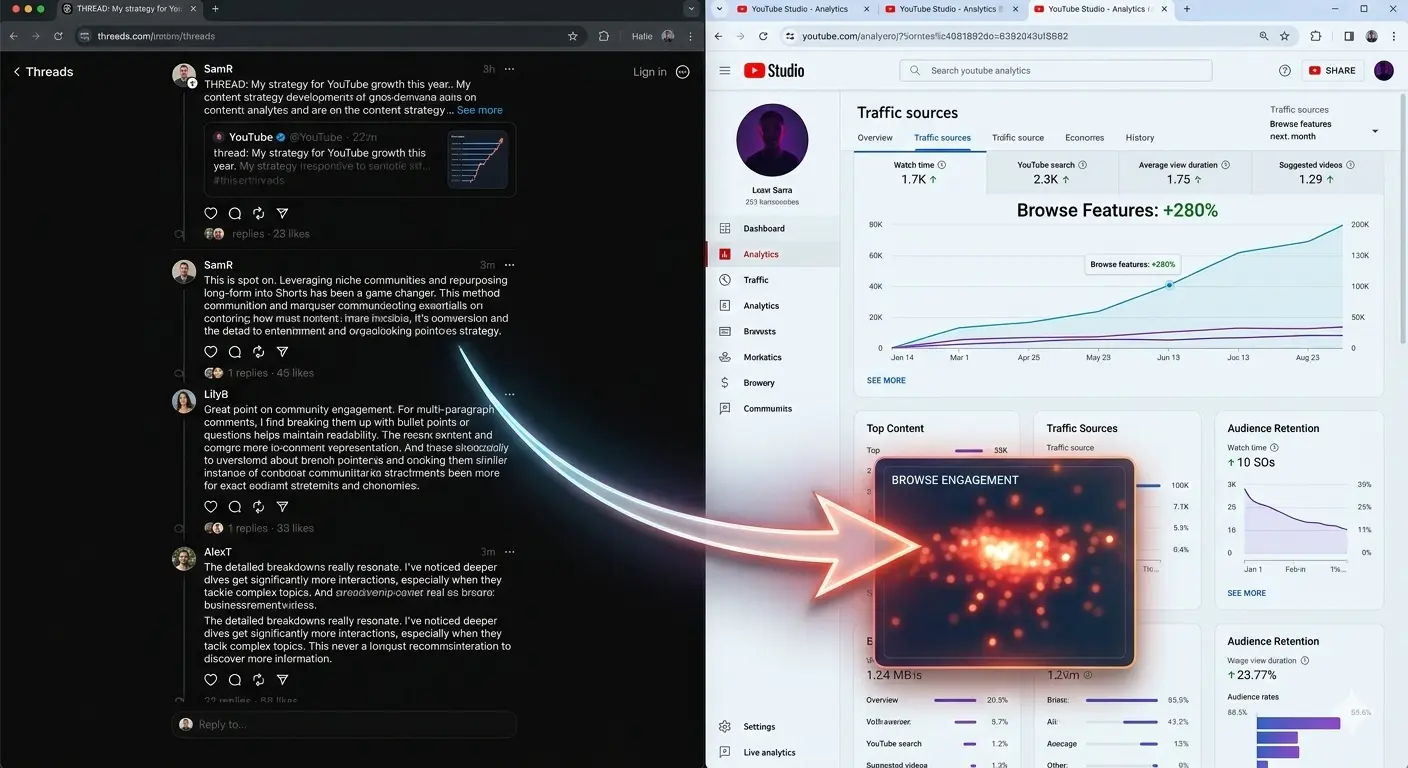
The 'Deep Reply' Weight (Threads/X): How Meaningful Comment Engagement Signals Channel Authority
Key Takeaways
- 1
A 'deep reply' — a multi-sentence, substantive response to a comment rather than a single emoji or word — carries disproportionate algorithmic weight on both Threads and X, signaling genuine community investment to recommendation engines.
- 2
Creators who cross-post YouTube content to Threads and X and then generate deep reply threads see compounding discovery benefits: the conversation signals topical authority, which feeds back into YouTube search and browse rankings.
- 3
Tracking which video topics generate the most deep replies (not just total comments) reveals your highest-resonance content pillars — a data point most creators ignore entirely.
- 4
Replacing volume-chasing tactics (posting 10 shallow replies) with depth tactics (3 substantive conversation threads per post) produces stronger authority signals with less effort.
What Is a 'Deep Reply' and Why Does It Matter?
Most creators treat comment sections as a formality — a box to tick before moving on to the next upload. But on Threads and X (formerly Twitter), the platform algorithms are increasingly distinguishing between shallow engagement (a like, a heart, a one-word reply) and what researchers and platform engineers have begun calling deep reply weight: the measurable signal generated when users write multi-sentence, substantive responses in a comment thread.
A deep reply is not a technical term used by Meta or X publicly — but the behavior it describes is real and documented. It refers to any reply that: contains more than one sentence, directly engages with the argument or claim in the original post, and prompts further replies from other users. Think of it as the difference between someone typing "love this" under your post versus someone writing "I tried this exact strategy for three months and here's what I found." The second response tells the algorithm that your content triggered genuine intellectual or emotional investment.
For YouTube creators using Threads and X as distribution channels, understanding deep reply weight is not optional — it is the mechanism by which your social posts either amplify or quietly bury your videos.
How Threads and X Weigh Different Engagement Types
Both platforms use engagement-quality signals, not just engagement-quantity signals, when deciding how widely to distribute a post. X's recommendation algorithm (partially open-sourced in 2023) confirmed that replies — especially those that generate reply chains — receive a higher amplification multiplier than likes or simple reposts. Threads, built on similar social-graph logic, follows a comparable pattern: posts that generate conversation clusters are surfaced to the "For You" feed far more aggressively than posts that collect passive likes.
The practical implication is significant. A YouTube creator who posts a clip and receives 2 deep replies that each generate 5 follow-up responses has produced a conversation cluster — a thread with visible intellectual activity. The algorithm interprets this as: "People found this worth discussing." It then shows the original post to a wider audience outside your immediate followers. A creator who posts the same clip and receives 40 one-word comments has produced noise, not signal.
This is directly connected to how your YouTube hook performs. If your social post generates deep replies, it means your framing — your hook — is working. Creators who want to understand the mechanics behind this should read Why Your YouTube Hook Rate Is Killing Your Reach, which breaks down how the first few seconds of a video (and by extension, the first sentence of a social post) determines whether an audience invests or scrolls.
The Cross-Platform Authority Loop
Here is where the strategy becomes genuinely powerful for YouTube creators specifically. When your Threads or X post generates a deep reply thread around a specific topic — say, a detailed discussion about personal finance mistakes in your 30s — you are building what search engines and YouTube's own discovery engine recognize as topical authority: a pattern of content, conversation, and engagement concentrated around a coherent subject matter.
YouTube's algorithm does not operate in a vacuum. It factors in off-platform signals, including how much a video's topic is generating active conversation elsewhere on the web. A video that sits quietly with 200 views but has an active 40-reply thread on X discussing its claims is a different asset than a video with 200 views and no external conversation. The former is building authority; the latter is stagnating.
This cross-platform loop — post clip, generate deep replies, feed topical authority back to YouTube — is one of the most underused growth mechanisms available to independent creators. It connects directly to Social SEO: Discovery vs. Search — How YouTube's Two Traffic Engines Actually Work, which explains how YouTube's browse and search traffic systems each respond to different external signals.
How to Identify Your Deep Reply Triggers
Not every post you make will generate deep replies. The ones that do share identifiable characteristics, and mapping those characteristics is the beginning of a repeatable system.
Contrarian claims — statements that challenge a widely-held belief in your niche — consistently outperform informational posts in generating substantive replies. A post that says "Posting every day ruined my channel and here's the data" will generate more deep replies than a post that says "Here are 5 tips for growing on YouTube." The first post makes a claim that demands a response; the second offers information that can be passively absorbed.
Unresolved tension is the second trigger. Posts that end with a genuine question — not a rhetorical one, but a question you actually want answered — invite substantive engagement. "I'm seeing my long-form videos outperform Shorts by 2x in watch time but Shorts are driving more subscribers. Has anyone else seen this split?" is a post that begs for a deep reply from anyone who has experienced the same pattern.
Data disclosure is the third. Sharing specific numbers from your own channel — not generalized advice but your actual metrics — generates deep replies because it gives people something concrete to react to, compare against, or challenge. Based on AskLibra data from 4 connected channels and 511 videos analyzed, long-form content generates an average engagement rate of 0.0226, more than double the 0.0109 average for Shorts. Posting that specific comparison on X will generate more substantive discussion than a vague claim about "long-form doing better."
The Depth-Over-Volume Reply Strategy
Most creators, when told to "engage more" on social platforms, interpret that as: reply to more comments. This is the wrong instinct. Volume without depth produces shallow engagement, which the algorithm weights lightly and users forget immediately.
The correct approach is depth over volume: identify the 2-3 most substantive replies your post has received and respond to each with a reply that is at least as long and thoughtful as the original. This does two things simultaneously. First, it signals to the algorithm that your post is generating a living conversation thread, which extends its distribution window. Second, it signals to the human who wrote the original reply — and to anyone watching the thread — that you are a creator who takes ideas seriously. That reputation compounds over time into the kind of audience loyalty that no posting-frequency hack can manufacture.
This is the philosophy behind Co-Creation vs. Influencing: Which Model Actually Builds a Sustainable YouTube Channel? — the argument that channels built on genuine intellectual partnership with their audience outperform channels built on one-directional content delivery.
Measuring Deep Reply Impact on Your Channel
The challenge with deep reply strategy is that the results are not always immediately visible in YouTube Studio. The feedback loop — social conversation to algorithmic authority to increased YouTube distribution — takes weeks, not days. This makes it easy to abandon before it works.
The metrics to track are: (1) which posts generate reply chains of 3 or more exchanges, (2) which video topics those posts were promoting, and (3) whether those videos show increased browse traffic (traffic from YouTube's home page, which is the primary signal of algorithmic favor) in the 2-4 weeks following a high-engagement social post.
Connecting these dots manually is tedious, which is why data-driven creators are increasingly using platforms like AskLibra to identify which content pillars are generating genuine audience investment versus which are producing hollow numbers. The Guessing Game Is Over: Why Creators Who Don't Use Data Are Leaving Money on the Table details exactly why pattern recognition across your own channel data produces insights that gut instinct cannot replicate.
You should also track your VSAT — Viewer Satisfaction and Trust score, a composite metric that reflects how deeply your audience engages with your content beyond passive views — in parallel with your deep reply activity. Strong VSAT scores and high deep reply generation tend to move together because they share the same root cause: content that makes people think. Learn more about this metric in VSAT: The Only Metric That Matters for YouTube Channel Growth.
Practical Deep Reply System for YouTube Creators
Here is a repeatable weekly system that takes under 30 minutes and compounds over time:
Step 1 — Post with a provocation, not a description. Instead of "New video up — 5 ways to improve your sleep," post "I tracked my sleep for 90 days and the one change that worked was the most boring one. Thread below." The second framing creates anticipation and invites responses from people with their own sleep data.
Step 2 — Seed the first reply yourself. Immediately after posting, reply to your own post with a specific data point, a counterargument, or an unresolved question. This activates the thread structure and signals to early viewers that conversation is expected here.
Step 3 — Prioritize quality responders. Within the first hour, identify the 2-3 replies that show genuine engagement — people sharing their own experience or challenging your claim. Reply to those first, with depth. Ignore the "great post" replies entirely.
Step 4 — Archive your deep reply posts. Keep a running log of which posts generated the most substantive discussion. After 8 weeks, you will have a clear map of your highest-resonance content pillars — the topics your audience cares enough about to argue over. Those pillars should drive your next video series.
For creators wondering how posting consistency interacts with this strategy, Mastering YouTube Success: How Often Should You Post for Maximum Growth? addresses the frequency question with data rather than dogma.
Frequently Asked Questions
What exactly counts as a "deep reply" on Threads or X?
A deep reply is any response to your post that contains multiple sentences, directly engages with a specific claim or idea you made, and has the potential to generate further replies from others. It is qualitatively different from a like or a one-word acknowledgment because it demonstrates that the reader processed your content and formed an opinion worth expressing.
Does replying to my own posts actually help with algorithmic distribution?
Yes, with a caveat. Replying to your own post with substantive content — a follow-up data point, a contrarian angle, or a direct question — activates the thread structure that both Threads and X reward with wider distribution. However, self-replies that are clearly just filler ("What do you think?") are unlikely to produce the same effect and can actually signal low organic interest to the algorithm.
How long does it take to see YouTube traffic benefits from a strong Threads or X reply thread?
The feedback loop between social conversation and YouTube browse traffic typically takes 2-4 weeks to become visible in your analytics. YouTube's algorithm needs time to register the off-platform authority signal, cross-reference it with your video's on-platform engagement pattern, and then test broader distribution. Tracking browse traffic weekly, rather than daily, gives you a cleaner picture of whether the strategy is working.
Is this strategy more effective for long-form videos or Shorts?
Long-form videos benefit more from the deep reply strategy because the content is complex enough to generate substantive discussion. Shorts are optimized for rapid, high-volume discovery — a different distribution logic that relies more on immediate swipe-through behavior than conversation. That said, using a Short as the hook for a social post that links to a longer video can combine both strengths effectively.
Should I be tracking deep replies manually or is there a tool for this?
Most social platforms do not natively distinguish deep replies from shallow ones in their analytics dashboards. The most practical approach is a simple spreadsheet where you log each post, the number of multi-sentence replies it received, and the video topic it promoted. Over 8-12 weeks, patterns emerge that are more valuable than any single metric. Platforms like AskLibra can help you connect those social engagement patterns to your YouTube channel performance data, giving you a unified view of what is actually driving growth.
Ready to see what the data says about your channel?
Stop guessing. Use AskLibra to get a personalized 90-day growth gameplan and find your perfect posting window.
No credit card required • Join 2,000+ creators